
When I began the Master in Sustainability Management & Business Impact at EADA Business School in Barcelona, I thought I was enrolling in a programme mainly focused on renewable energy, circular economy models, and responsible supply chains. I imagined sustainability as something technical and forward-looking, almost like a design challenge at a global scale.
What I didn’t expect was that my academic experience would push me to question something much deeper: the very structure of the economic system we operate in, who it serves, and who it leaves behind. What I have come to realize is that sustainability education is not only about learning solutions, it is about questioning the system that created the problems in the first place.
From Networking Event to Systemic Questions
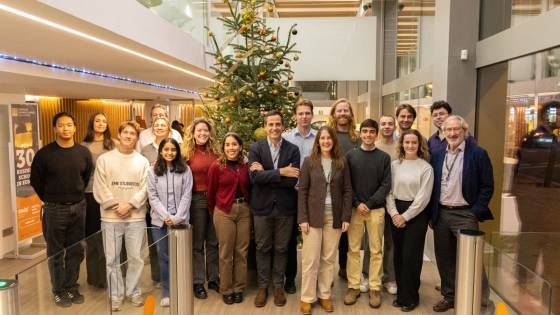
Being part of the Sustainability Club at EADA Business School has played a big role in that shift. Our first major event last year was centered on networking. It sounded like a typical professional activity meeting people, exchanging contacts, exploring career paths. But the conversations that emerged were far from superficial. Professionals spoke about the tension they experience when defending sustainability initiatives in the company where financial metrics still dominate decision-making. Others spoke about trying to create change from within organizations that still measure success. That event made something clear: sustainable leadership is not only about having the right tools. It is about navigating contradiction, resistance, and uncertainty.

Climate Change, Inequality and the Global System
At the same time, my courses were expanding this perspective. At first, we studied topics such as climate change, resource scarcity, supply chain impacts. But slowly, a broader pattern became visible. These crises are not isolated problems; they are symptoms of a global system built on unequal exchange.
Historically, industrialized countries developed by extracting raw materials, labor, and environmental capacity from other regions. Today, this dynamic hasn’t disappeared; it has simply become more complex and less visible. The minerals needed for renewable technologies often come from vulnerable communities. Fast fashion depends on low-paid labor far from the consumers who buy the clothes. Waste and pollution are frequently outsourced to places with fewer protections.
Through this lens, sustainability stopped feeling like a technical challenge and started to look like a question of justice.
The countries and communities contributing least to environmental degradation often suffer its most severe consequences. Climate change, water scarcity, and pollution do not affect everyone equally. Learning this in an academic setting is uncomfortable, because it forces us to see that the global economy is not neutral. It produces both wealth and inequality at the same time.
When Sustainability Becomes Political
Another layer of complexity comes from the current political climate. In some parts of the world, sustainability is no longer framed as an opportunity for innovation and long-term resilience. Instead, it is increasingly portrayed as a cost or even as a political position. This shift influences companies. When environmental and social goals lose political support, corporate commitments often become weaker, especially when they seem to conflict with short-term financial performance.
As a student studying sustainable business in Barcelona, witnessing this shift is eye-opening. Sustainability is not a guaranteed priority; it is something that must constantly be defended, explained, and reframed. Education in this field is not only about learning tools and frameworks. It is about preparing to work in environments where the value of sustainability itself may be questioned.
Questioning Capitalism and Redefining Profit
One of the most challenging discussions throughout my academic journey, here at EADA, has been about capitalism. Traditional models prioritize growth, profit maximization, and shareholder value. Yet ecological limits and social inequality reveal the limits of this logic. We live on a finite planet, but our dominant economic system depends on continuous expansion. This tension helps explain why wealth tends to accumulate in certain regions and groups, while environmental and social costs are externalized elsewhere. Rich countries remain rich, and poorer regions often remain locked in extractive roles.
However, one of the most hopeful aspects of my learning experience has been discovering companies trying to rethink what profit means. A strong example is Ferrer, a pharmaceutical company that promotes the idea that profit should be a mean rather than the ultimate goal. In this view, financial performance becomes a tool to generate positive social and environmental impact, not an end in itself. Impact becomes the purpose. Profit becomes the resource that enables it.
Seeing real organizations adopt this mindset changes how I understand responsible business strategy. It suggests that companies do not necessarily have to choose between performance and responsibility. They can redefine what performance actually means.


What Studying Sustainability Management & Business Impact at EADA Really Teaches You
We, as students entering the workforce now, face a complex moment: climate urgency, political polarization, technological acceleration, and rising inequality all at once. It is easy to feel that the challenges are too large. Yet our academic experience is preparing us for exactly this complexity. We are learning not only technical skills but also how to question assumptions, integrate ethics into strategy, and challenge extractive models of value creation.
Sustainability is not just about protecting nature. It is about redefining the relationship between business, society, and the planet. It requires us to confront uncomfortable truths about inequality and power, but it also opens the door to reimagining what success looks like.
If there is one piece of advice I would give to future students considering a Master in Sustainability Management & Business Impact at EADA, it is this:
Be prepared not only to learn tools and frameworks, but to question assumptions. The most transformative part of this journey may not be the technical knowledge you acquire, but the perspective you develop.
Those conversations that started in a networking event, continued in classrooms, and expanded through group discussions are shaping how I see my future role. And perhaps changing the questions is the first step toward changing the system itself.

Author
Ana Hernández Gallegos
Participant - International Master in Sustainability Management & Business Impact 2025-2026