
I study International Master in Tourism & Hospitality Management at EADA Business School in Barcelona, and recently, I experienced something that completely transformed the way I see this industry - not from a lecture hall, not from a case study, but from the inside.
As part of the Master’s in Tourism & Hospitality Management, I took part in the International Business Immersion Exeperience (IBI), a three-day field trip to Mallorca that brought experiential learning to life in a way no classroom could.
Between March 9th and 11th, we stepped directly into the world of hospitality and tourism. The itinerary was unlike anything I had expected. It wasn't a standard study tour. It was a full business and guest experience hybrid: seminars with industry leaders in the morning, and actual immersion as a guest in the afternoon. We saw companies from the inside out, and we also experienced what it means to be on the receiving end of exceptional hospitality.
Here is what I learned.
Day 1 - Palma: Giants, Empires & a Boutique Gem
Stop 1 - Meliá Hotels International Headquarters
Our day began at one of the most iconic names in global hospitality - Meliá Hotels International. Walking into their headquarters in Palma, I had one of those moments where you realize the scale of what a single vision - and a Mallorcan family - can create.
Meliá started as a family business right here on this island. Today, it is one of the world's leading hotel groups, present in dozens of countries. The presentation we received on brand portfolio and marketing strategy was a masterclass in how to build and manage multiple brands under one corporate umbrella - each one targeting a different segment, each one carrying its own identity, and yet all anchored to a shared corporate vision. We saw how global strategy gets translated into localized execution, how digital innovation is shaping the guest experience of tomorrow, and how a company of this scale balances standardization with market-specific needs.
What struck me the most was the origin story. It is easy to see Meliá as an untouchable corporate giant. But knowing it started as a family business right where we were standing - in Mallorca - made everything feel more tangible. It was a reminder that big things begin with one great idea and the courage to act on it.
Stop 2 - AVORIS Travel Agency
A short walk from Meliá brought us to AVORIS, one of Spain's leading travel and tourism companies, and part of the Barceló Group. This visit was a revelation in understanding vertical integration.
The group controls the entire tourism value chain - from aviation and bus transportation, to travel agencies and hotel operations - they control every touchpoint in the journey. As a tourism student, this was a live case study in how integrated business models create competitive advantage.
Seeing the inner workings of how a travel agency like AVORIS designs packages, handles client relationships, and deploys marketing strategies to stay competitive in a fast-changing market was incredibly eye-opening. The tourism industry moves fast - digitalization, shifting consumer behaviors, geopolitical changes - and companies like AVORIS are constantly adapting. This was hospitality and tourism strategy in real time.
Stop 3 - Hotel Glòria de Sant Jaume & Fundación Palma365
The day ended with an experience that perfectly combined luxury hospitality and destination management.
Hotel Glòria de Sant Jaume is a boutique luxury property nestled in the heart of Palma's old town, where Mallorcan heritage meets contemporary elegance. Every detail felt intentional. As we explored the space, we weren’t just observing—we were experiencing. And that is exactly the point.
The highlight of the afternoon was the lecture by Pedro Homar Oliver, Director of Fundación Palma365, a public-private partnership that works towards the sustainable development of Mallorca as a year-round tourism destination. Pedro's presentation was one of the most practically valuable sessions I have attended. Pedro walked us through their market segmentation, targeting strategy, repositioning, and the challenges of managing a world-famous destination that risks being overwhelmed by its own success.
This talk proved something I believe very deeply: when the public and private sectors genuinely collaborate, tourism becomes transformative. Without that alignment, even the most successful destinations risk being overwhelmed. This wasn’t theory. This was reality—and it showed me what modern tourism education should look like.
We also enjoyed some beautiful finger food along the way - because in hospitality, even the snacks tell a story.
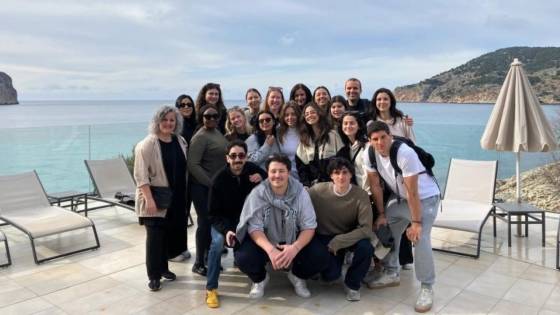

Day 2 - Camp de Mar: Where Marketing Meets the Mediterranean
Bahía Suites Camp de Mar - Cabau Hotels
We started the day heading towards the coast, and the setting alone was inspiring. Arriving at Bahía Suites Camp de Mar felt like arriving at a postcard.
We started the morning with a lecture from Helena V., marketing specialist for Cabau Hotels - a family-run hotel group navigating the complexities of growing a brand while preserving its identity.
The discussion focused on key questions:
How do you scale?
How do you professionalise without losing the soul?
How do you position your brand in a crowded luxury market without following the crowd?
Her insights were raw, honest, and incredibly useful.
And then, the learning continued—just in a different format.
An afternoon by the sea, experiencing yoga on the beach, wellness, service, and atmosphere firsthand. Because this is something I truly understood during the trip: experiencing the product is understanding the product.
When you feel what great hospitality feels like—when you notice the details, the atmosphere, the emotional impact—that is guest experience analysis. That is real learning.
Day 3 - Mallorca Beyond Tourism: Product, Passion & Reinvention
Stop 1 - Treurer: The World's Best Olive Oil
The last day started with what I will remember as one of the most unexpectedly profound business experiences of my time at EADA. Our final day took us into the countryside, to - Treurer —an olive oil estate that felt more like Tuscany than Mallorca.
We met the owner, Miguel Miralles, and quickly understood that this was more than a business—it was a passion-driven project built on precision and excellence.
Treurer produces award-winning extra virgin olive oil. We learned about the full production process: from cultivation and organic protection methods to chemical analysis and certification. Every step is controlled, measured, and refined. The certification process alone is expensive, demanding and rigorous, and Miguel pursues it every single year. Treurer has won numerous international prizes, and tasting the oil confirmed everything. When someone is deeply committed to quality, it becomes impossible to replicate.
Miguel also shared something beautiful about the identity of Treurer. The name itself comes from the Mallorcan word for 'tresor' - treasure. And the logo features a lock, a symbol of keeping the secret of excellence safe. Across the valley, on top of a mountain, sits one of Mallorca's most important monasteries. Miguel believes the proximity of this sacred place creates a special synergy with the land.
Stop 2 - Rondaia: Reinventing Tradition
Our final stop was Rondaia - a family estate that transformed its agricultural past into a modern wine and hospitality business.
Originally focused on orange production, the family reimagined their future and created a vineyard producing high-quality wines, alongside premium accommodation experiences.
This is a perfect example of business reinvention. The land didn’t change. The vision did.
Today, Rondaia produces white wine and rosé and also operates eight premium housing apartments. Standing there, you could feel something rare—space, calm, authenticity. A version of Mallorca that goes beyond mass tourism.


What I'm Taking Away
Three days, six organizations, a dozen industry leaders and one island - and I returned to Barcelona with a completely new understanding of the tourism and hospitality industry. Here is what the IBI Experience taught me:
- Every great company starts with vision and belief
- Public and private collaboration is essential for sustainable tourism
- Passion creates true differentiation
- Experiential learning is the most powerful form of education
- Reinvention is always possible
Every great company started with one person who truly believed. Meliá began as a family business in Mallorca. Barceló too. Treurer is one person's obsession turned world-class product. Rondaia is generations of family courage. The scale differs, but the origin is always the same: vision and conviction.
Public and private sectors must work together. Pedro Homar's lecture at Fundación Palma365 showed me that destination management is not a solo act. Sustainable tourism requires dialogue, alignment and shared responsibility between government, businesses and communities.
Passion is a competitive advantage. Miguel Miralles doesn't just produce olive oil - he is consumed by the pursuit of perfection. That kind of passion is not replicable. It is what separates a good product from the best product in the world.
Experience is knowledge. Lying by the pool at Bahía Suites after a marketing seminar was not a break from learning - it was learning. When you feel what great hospitality feels like, you understand it at a level that no textbook can replicate.
Reinvention is always an option. Rondaia turned orange groves into vineyards. The land did not change. The vision did. In business and in life, the ability to reimagine what you have is one of the most powerful skills there is.
A Note of Gratitude
I would like to thank EADA Business School for designing an academic experience that goes beyond the classroom and places students directly in the industry. This is what transformative education looks like.
This International Business Immersion showed me that studying tourism and hospitality is not just about learning concepts—it’s about living them. A special thank you as well to everyone who contributed to making this experience possible—from industry professionals to organisers and alumni who shared their time, insights, and expertise.

Author
Nicole Burdzhieva
Participant - International Master in Master in Tourism and Hospitality Management 2025-2026