
EADA ranks once again among the world’s Top 100 MBAs in the Financial Times 2026 Ranking
EADA’s MBA stands out among the global Top 5 for sustainability and Top 10 for sectoral diversity, reaffirming Barcelona’s leadership as an international hub for executive education.
EADA Business School has once again been ranked among the world’s top 100 business schools for MBA programmes, according to the Global MBA Ranking 2026 published by the Financial Times, widely regarded as the most rigorous and influential ranking in executive education worldwide.
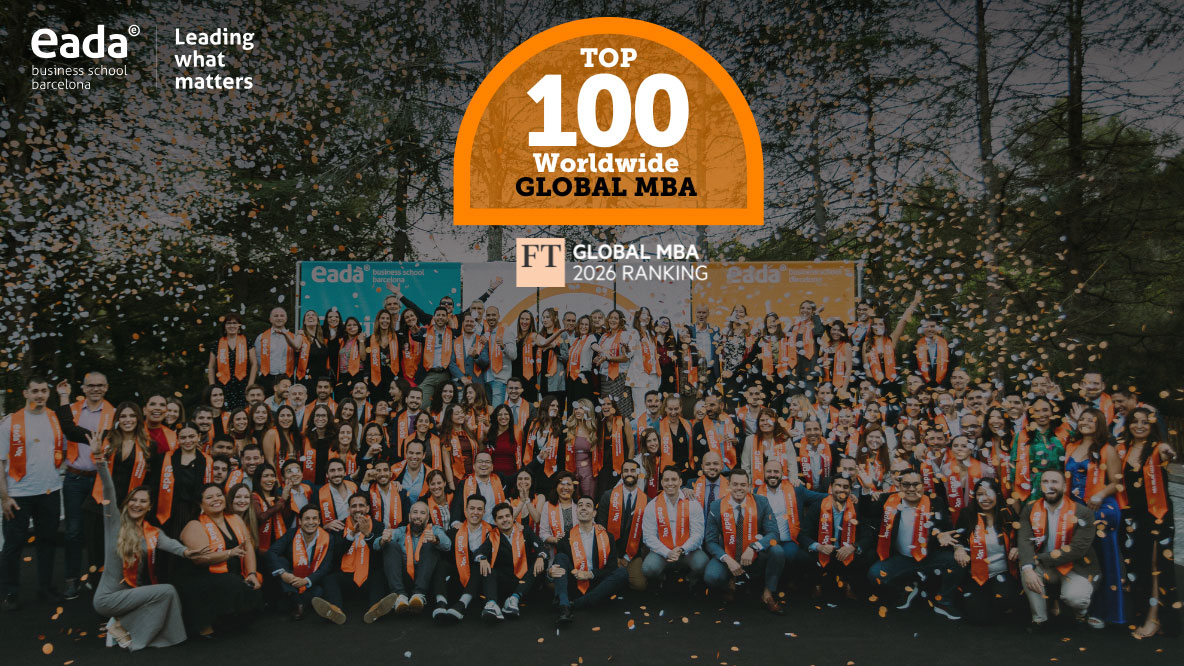
In this edition, EADA rises to position 95, climbing five places compared to the previous year and consolidating its presence in the global Top 100 for the fourth consecutive year.
A benchmark MBA in sustainability and responsible leadership
One of the most notable highlights of the ranking is the recognition of the transformative approach of EADA’s MBA. The Financial Times ranks the programme:
- Top 5 worldwide for the proportion of teaching hours devoted to ESG and net zero.
- Top 10 worldwide for the sectoral diversity of participants’ professional backgrounds.
This positioning reinforces the school’s strategic commitment to embedding sustainability, business ethics, social impact and climate action into the education of future leaders.
As Ella Boniuk, Director of EADA’s International MBA, states: “It is not only about training executives, but about doing so by placing sustainability at the core of addressing business challenges that are profitable while also generating positive impact.”
In a business environment shaped by the green transition, digital transformation and increasing corporate responsibility demands, MBA education must go beyond traditional management. EADA’s approach combines academic rigour, intensive leadership development and experiential learning in real-world contexts.
What makes an EADA MBA different?
EADA’s MBA programmes are designed for professionals with at least three years of experience who aim to accelerate their careers, redefine their professional paths or take on greater responsibilities.
Key strengths include:
- A global and international business perspective.
- Faculty with real executive experience.
- Experiential methodology and intensive leadership development.
- High international and sectoral diversity in the classroom.
- Strong links with the corporate world.
Furthermore, the Financial Times ranking evaluates key indicators such as alumni career progression, salary increase, internationalisation, diversity and faculty quality, reinforcing the strategic value of an MBA as a professional investment.
Barcelona, an international hub for executive education
The presence of three Barcelona-based business schools in the global Top 100 once again confirms the city’s position as one of Europe’s leading hubs for executive education and international talent.
Barcelona combines a dynamic business ecosystem, global outlook and quality of life, enhancing the transformative experience of pursuing an MBA in the city.
Nearly seven decades developing impactful leaders
Founded in 1957 as an independent institution, EADA Business School holds international accreditations such as EQUIS and AMBA, guaranteeing the academic excellence of its MBA programmes.
Over the past decade, the school has strengthened its commitment to sustainability through pioneering programmes in Europe and the cross-cutting integration of ESG criteria across all its management programmes.
EADA’s institutional purpose, Leading What Matters, reflects its commitment to developing leaders capable of generating positive impact within organisations and society.
